Influencer Marketing Strategy: The Ultimate Guide for Shopify Brands
The complete end-to-end framework for influencer marketing strategy. From discovering the right creators to optimising long-term relationships, learn how to build a high-performance creator engine for your Shopify brand.
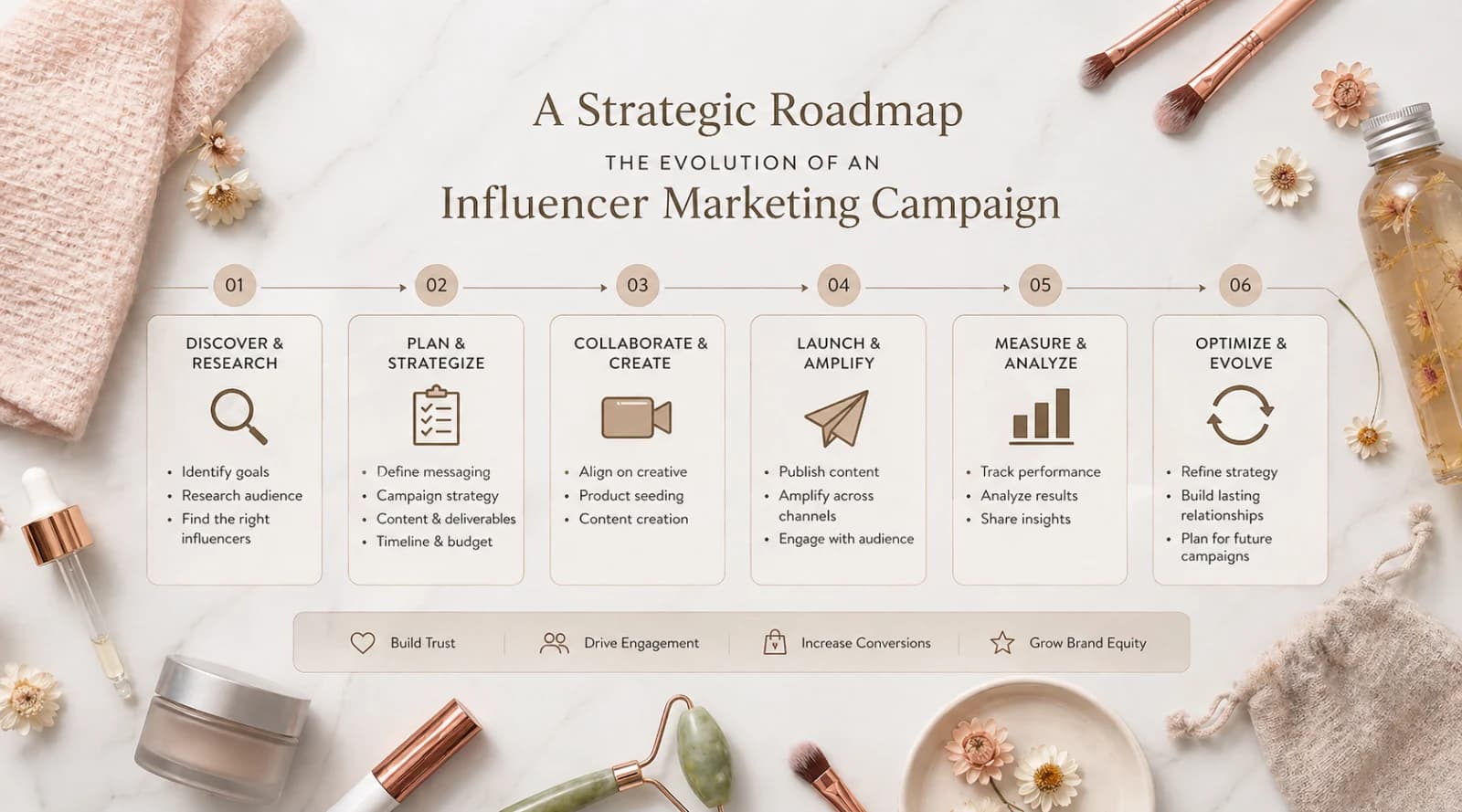
Building a successful influencer marketing strategy is no longer just about finding people with large followings. In 2026, it's about alignment, credibility, and systematic execution: a repeatable engine that compounds over time.
This pillar page is your central framework for mastering the full influencer lifecycle. Whether you are a new Shopify store finding your first ten creators, or an established brand managing hundreds of relationships, these six phases give you a complete operating model from initial discovery through to long-term optimisation.
Table of Contents
- Discover & Research
- Plan & Strategize
- Collaborate & Create
- Launch & Amplify
- Measure & Analyze
- Optimize & Evolve
- Goals & Outcomes
1. Discover & Research
Every high-ROI campaign starts long before the first DM is sent. The discovery phase is where you define what success looks like, understand who you are trying to reach, and build the shortlist of creators who can credibly reach them.
Identify Goals
Before you look at a single creator profile, you need a single, unambiguous objective. Are you building brand awareness in a new category? Driving direct Shopify revenue? Growing your content library for paid ads? Each objective shapes every decision that follows: the creator tier you target, the platform you prioritise, and the metrics you use to measure success.
A common mistake is launching with a vague goal like "grow brand visibility." Instead, define a North Star Metric for the campaign:
- Traffic: UTM-tracked clicks to a landing page
- Sales: Conversions through creator-specific discount codes
- Content Library: Volume of UGC generated for repurposing
Pick one. Match every subsequent decision to it.
Research Audience
Success starts with targeting. If you try to appeal to everyone, you appeal to no one. Before you can find the right creators, you need a precise picture of your ideal customer: not just their demographics, but their interests, sub-cultures, and digital habits.
Map what your customer cares about outside your product. A skincare buyer likely follows wellness creators. A home gym customer might follow productivity and biohacking accounts. Find the digital communities where your ideal customer already spends their time, because those communities are where your creators live.
Go beyond "Women aged 25-34." Identify the specific niches, problems, and interests that define your segment. This is the foundation for finding creators whose audiences are pre-qualified for your product.
Find the Right Influencers
Finding "big" creators is easy. Finding the right creators is where the ROI lives. The most powerful insight in modern influencer strategy is this: follower count is a vanity metric, and niche fit is everything.
The data is unambiguous. Nano-influencers (under 10,000 followers) deliver an average engagement rate of 2.53% on Instagram and 18% on TikTok, compared to just 0.92% for mega-influencers. That is not a small gap. A well-targeted nano creator can outperform a star with a million followers at a fraction of the cost.
Why? Because niche audiences follow creators for one or two very specific reasons. Skincare routines. Clean eating. Home gym setups. When that creator recommends a product that fits their niche, it lands like a recommendation from a trusted friend, not an advertisement.
When building your discovery shortlist, filter by:
- Relevance: Are they already talking about your category or solving the problem your product addresses?
- Audience Alignment: Does their audience match your target geography, interest profile, and intent level?
- Engagement Depth: A 10k creator with a 5% engagement rate is almost always more valuable than a 100k creator with a 0.5% rate.
- Authenticity: Check for sudden follower spikes, bot-like comments, and inconsistent engagement. The fake follower problem is far more common at the macro tier.
For a step-by-step guide to targeting the right niches for your brand, read How to Find the Perfect Influencer Niche. To understand the performance data behind creator tiers in depth, see Why Micro-Influencers Outperform Macro-Influencers. When you are ready to find creators, use the TikTok Exporter to identify top creators and trending topics in any niche.
2. Plan & Strategize
Discovery gives you a shortlist. Strategy gives you a campaign that is coherent, cost-controlled, and set up to be measured. This is the phase where you define what you are going to say, how you are going to say it, what you need from each creator, and what it will cost.
Define Messaging
Your messaging framework is the bridge between your brand's identity and the creator's authentic voice. The goal is to arrive at a set of core truths about your product that any creator can express in their own style, without compromising your brand safety or diluting the core idea.
Start from the problem, not the product. What specific, recurring problem does your product solve? Who experiences it? What does their life look like before and after? When creators are briefed on the purpose rather than a list of features, they produce content that resonates rather than reads like a script.
Alongside the core message, define what is mandatory (correct brand name pronunciation, discount codes, disclosure tags, specific claims) and what is off-limits (competitor inclusions, claims you cannot substantiate, content that falls outside your brand standards). These boundaries protect your brand without strangling creativity.
Campaign Strategy
With your audience research and messaging framework in place, you can now design the campaign structure. The Essential Influencer Collaboration Checklist provides a full pre-campaign checklist, but the core decisions are:
- Platform: Does your product shine in TikTok's fast-paced format, or does it benefit from a longer YouTube review? Match the platform to how your audience discovers and evaluates products.
- Creator Mix: Consider a portfolio approach. A combination of nano and micro-influencers delivers broad niche coverage and high engagement. Mid-tier creators add reach. The mix depends on your objective and budget.
- Seeding vs. Paid: Product gifting (seeding) generates authentic organic content at scale and builds lasting affiliate relationships. Paid sponsorships offer more control over timing and deliverables. Many high-performing campaigns use both. The Ultimate Guide to Influencer Seeding covers the seeding model in full.
- Volume: At the nano and micro tier, volume matters. We recommend building a pipeline of 100-150 creators per week, seeding broadly, letting the best performers surface naturally, and then doubling down on those relationships.
Content & Deliverables
Be explicit about what you need from each creator before any agreement is signed. Vague deliverable specs are one of the most common causes of campaign friction, and they are entirely avoidable.
Define the number and type of posts (Reels, Stories, long-form video, static posts), duration and format requirements, mandatory elements (tags, affiliate links, promo codes, CTAs, disclosure language), content that is not acceptable (competitor inclusions, unverifiable claims, off-brand aesthetics), and usage rights. If you plan to repurpose their content in paid media, define this upfront. These conversations become significantly harder and more expensive once great content already exists. Use the Influencer Contract Generator to formalise deliverables and usage rights before content is created.
Timeline & Budget
A realistic budget accounts for more than creator fees. Include product costs, fulfilment and shipping, software tools, and any paid amplification you plan to layer on top of organic creator content.
Build your timeline backwards from your campaign launch date. Allow time for outreach and agreement, shipping and delivery, content creation, your review window, and publication. For gifting campaigns, shipping lead times alone can span two to three weeks.
On budget allocation: consider the seeding economics. For the equivalent of one macro sponsored post, you can seed your product to 200-500 nano-influencers, generating a content library, organic brand mentions, and a pool of affiliate partners. As covered in How to Scale to $1M with Influencer Marketing, the long-tail ROI of seeding accrues over six to twelve months, and most brands running short-window attribution models significantly undercount seeding's real contribution. Use the Gifting ROI Calculator to model your budget against expected returns before you commit.
3. Collaborate & Create
This is the phase where strategy becomes relationship. How you onboard creators, brief them, and manage the creation process determines whether you get authentic, high-converting content or stilted, scripted posts that audiences scroll past.
Align on Creative
Creators are not actors. They know their audience's inside jokes, what gets shared in the group chat, and exactly how to frame a product recommendation so it lands like a conversation rather than a commercial. Your job is to give them enough direction to protect brand safety and ensure your key message comes through, without stripping out the voice that made their audience trust them in the first place.
The tool that achieves this is a one-page brief. Not a 20-slide PDF packed with product specifications and legal jargon. A focused, single-page document that covers five things, as detailed in The One-Page Influencer Brief Template:
- Campaign Outcome: What should the audience understand, feel, and do after watching?
- Audience & Problem: Who are we talking to, and what problem does this product solve for them?
- Key Messaging: The non-negotiables: correct brand name, core benefit, discount code, required disclosure.
- Visual Direction: Tone, setting, and what to avoid. A small number of clear signals, not a mood board dump.
- Post Criteria: Tags, links, CTAs, disclosure requirements, and what is explicitly off-limits.
The brief and the agreement work as a pair. The brief sets the creative direction; the agreement protects the outcome. Ensure your agreement covers how long content must remain live, usage and licensing rights, revision rounds, and specific deliverable standards. The Influencer Contract Generator makes this straightforward.
Product Seeding
Product gifting is the activation mechanism for your campaign. How you ship and present your product sends a signal about your brand before a single frame of content is created. A well-packaged product that arrives on time, with a clear and friendly note, creates a positive first impression that carries into the content.
Operationally, seeding at scale requires a system. Manual tracking of addresses, unique discount codes, and shipment status across hundreds of creators is where most campaigns break down. The brands that scale seeding successfully treat it as infrastructure: each creator gets a unique discount code automatically generated at onboarding, gifted orders are created directly in Shopify without manual copy-pasting, and shipment tracking is centralised rather than buried in email threads. For the foundational model, read What is Influencer Seeding? and The Five-Step Influencer Seeding Blueprint. The Creating Your First Campaign guide walks you through the setup on Sonar Seed.
Content Creation
Once product is in hand, your role shifts to relationship management. Avoid micromanaging. You hired creators for their voice, so let them use it. Your brief established the guardrails; trust them to work within those guardrails authentically.
Where review is needed, keep feedback specific and actionable. Reference the brief directly. This removes subjectivity from the conversation and makes correction requests feel collaborative rather than confrontational.
Consider how content quality can be elevated without adding production cost. Creators do not need a studio to produce high-converting UGC. Clear lighting, natural settings, and genuine product interaction consistently outperform polished, over-produced content on short-form platforms. How to Generate UGC Without a Production Studio covers this in detail. For the creative signals that drive virality on TikTok specifically, see How Hook, Aesthetic, and Niche Drive TikTok Virality in 2026.
4. Launch & Amplify
Creating great content is only half the equation. The launch and amplification phase determines how far that content travels and how much of its potential you actually capture.
Publish Content
Coordinate your publication window strategically. A concentrated burst of creator content across a short timeframe can trigger algorithmic lift on TikTok and Instagram. The platforms interpret high engagement volume as a signal to distribute content more broadly. This is the volume play strategy: rather than spacing creator posts evenly across weeks, you batch them into a concentrated window to amplify organic reach. The full mechanics of this approach are covered in The Algorithm Volume Play: TikTok & Instagram.
Ensure all creator posts meet your agreed standards before going live. Check that disclosure tags are present and visible, affiliate links and codes are correct, and required tags are included. Problems caught post-publication are significantly harder to resolve than problems caught at the review stage.
Amplify Across Channels
Creator content should not live exclusively on the creator's channel. High-performing organic content, particularly UGC that feels native and authentic, is your most cost-efficient paid media creative. Repurposing seeded content for Meta and TikTok ads delivers two compounding advantages.
First, lower CPMs: fresh, native-feeling creatives consistently outperform polished brand ads on short-form platforms, reducing your cost per thousand impressions. Second, continuous creative refresh: a library of creator content gives you an ongoing supply of ad variations, directly addressing the creative fatigue that erodes paid ad efficiency over time.
Ensure usage rights are formalised in your agreements before repurposing any creator content. For the broader short-form content strategy, see TikTok & UGC Growth: The 2026 Playbook and Shopify Growth: Scaling Your E-commerce Store.
Engage with Audience
When creator content is live, the conversation has started, and your brand's participation in that conversation matters. Responding to comments on creator posts, resharing content to your own brand channels, and engaging authentically with the audience signals credibility and keeps the content's momentum alive.
This is also where you identify your strongest performers in real time. Which posts are generating genuine questions about the product? Which creators are driving comment threads that look like peer recommendations? These early signals tell you who to invest in long-term.
5. Measure & Analyze
The post-campaign phase is not a postmortem. It is the input for your next campaign. The brands that improve fastest are the ones that measure with discipline and turn data into decisions.
Track Performance
Match your tracking methodology to your original North Star Metric. If you defined your goal as sales, UTM-tracked links and creator-specific discount codes are your primary measurement tools. If you defined it as content library growth, count the pieces of usable UGC generated. Avoid the trap of optimising for whichever metric looks best after the fact.
Key quantitative signals to track:
- Engagement Rate: The ratio of interactions to reach. A high ER relative to the creator's peer group signals an active, trusting community.
- Conversion Rate: Sales and traffic directly attributable to each creator's unique code or link.
- Content Reach: Organic impressions generated across all creator posts.
- UGC Volume: Total pieces of content available for repurposing.
Flag fake engagement before it pollutes your data. Generic emoji comments, sudden engagement spikes, and comment-to-follower ratios that do not match organic norms are all signals worth investigating, particularly for creators you have not worked with before.
Analyze Results
Quantitative data tells you what happened. Qualitative analysis tells you why. Read the comments on your highest and lowest performing posts. Did the audience ask genuine questions about the product? Did they engage with the creator's personal story, ignoring the brand entirely? Did specific content formats (tutorial vs. lifestyle vs. unboxing) consistently outperform others?
Compare performance across creator tiers, niches, and platforms. The insights that emerge, covering which sub-niches convert best, which content styles resonate, and which creator types build the strongest audience response, become the brief for your next campaign. The Essential Influencer Collaboration Checklist and Overcoming Influencer Seeding Challenges both provide frameworks for turning these lessons into process improvements.
Share Insights
Make your campaign learnings accessible to everyone who needs them, including the creators themselves. Sharing performance data with creators builds trust, signals that you take the partnership seriously, and gives them the context to improve. Creators who understand what worked and why will deliver better content on the next campaign.
Internally, document your findings in a format that can inform future briefing, creator selection, and budget decisions. Which niches drove the most value? Which platforms delivered the best ROI? Which content styles should you double down on? These are the questions that compound your results over time.
6. Optimize & Evolve
The brands that build lasting competitive advantages in influencer marketing are not the ones that run the best single campaign. They are the ones that build systems that improve with every iteration, compounding their content library, their creator relationships, and their strategic intelligence simultaneously.
Refine Strategy
Use the analysis from Phase 5 to update your targeting parameters, messaging framework, and creator selection criteria. If a particular niche consistently outperformed others, expand your creator pipeline there. If a content style drove significantly higher conversion, make it the default brief direction for your next campaign.
Eliminate what did not work with the same discipline you apply to doubling down on what did. Refine your vetting criteria. Update your brief template. Adjust your platform mix. Treat every campaign as a learning experiment that makes the next one more precise. Overcoming Influencer Seeding Challenges is a useful companion for this stage, covering the most common friction points and how to resolve them systematically.
Build Lasting Relationships
The highest-value creator relationships are not transactional. They are ongoing. When an audience sees the same creator use and recommend a product consistently over six months, the trust becomes unbreakable. That compounding credibility is something no single sponsored post can replicate.
Identify your top performers after every campaign and actively invest in those relationships. Prioritise them for new product launches and exclusive access. Transition strong seeding partners into formal affiliate relationships, where they earn commission on every sale they drive, creating a long-term incentive aligned with your growth. Maintain genuine communication between campaigns, not just when you need content.
Long-term affiliate programmes built on seeding relationships consistently become one of the highest-ROI channels for scaling brands. As detailed in How to Scale to $1M with Influencer Marketing, at the right scale an affiliate partner generating $2,000 per month in attributable sales has paid for the original gifting investment many times over, and keeps paying. The Blueprint for Influencer Credibility explains how to evaluate and protect the trust that makes these relationships work.
Plan for Future Campaigns
Scale is not achieved by running bigger versions of the same campaign. It is achieved by building infrastructure that can operate at volume without proportionally increasing team effort. As your creator programme grows, prioritise:
- Automation: Gifting order creation, unique discount code generation, and affiliate tracking should be handled by your platform, not your team's time.
- Creator CRM: A centralised record of every creator relationship, their performance history, content library, and communication log.
- Content Library Management: A growing, organised archive of creator content ready for paid media repurposing.
- Programme Tiers: A clear progression from gifted creator to affiliate to brand ambassador, with defined criteria and incentives at each level.
The brands that reach $1M on earned media treat their influencer programme as permanent infrastructure, not a series of one-off campaigns. Read the full scaling model in How to Scale to $1M with Influencer Marketing, and get started with the Creating Your First Campaign guide.
Start automating your creator programme with Sonar Seed
Goals & Outcomes
Every phase of the framework above serves one or more of four core outcomes. Understanding which outcome you are optimising for at any given time keeps your strategy coherent and your measurement meaningful.
Build Trust
Trust is the foundational currency of influencer marketing. It is what converts a creator mention into a peer recommendation, and a one-off campaign into long-term brand equity. Trust is built by choosing creators with genuine authority in their niche rather than just reach, briefing for authenticity rather than scripting for control, investing in long-term partnerships that audiences see over time, and maintaining transparency in disclosures, which counterintuitively increases audience trust in both creator and brand.
Brands that prioritise trust over short-term conversion consistently build more durable growth. The Blueprint for Influencer Credibility covers the four pillars of creator trust and how to audit them before you commit to a partnership.
Drive Engagement
Engagement is the signal that content is resonating: that the right message reached the right audience in the right format. High engagement rates at the nano and micro tier are driven by niche specificity. An audience follows a creator because of a very narrow, specific interest. When a brand recommendation aligns perfectly with that interest, it generates responses that look like peer conversation, not advertising.
As shown in the engagement rate data by creator tier, nano-influencers on TikTok deliver engagement rates that are more than 18 times higher than mega-influencers. Engagement also feeds the algorithm: concentrated, high-engagement bursts of creator content across a short window can trigger organic reach amplification, turning a well-coordinated campaign into significantly more impressions than the sum of individual posts. For the creative signals that drive this on TikTok, see How Hook, Aesthetic, and Niche Drive TikTok Virality in 2026.
Increase Conversions
Conversion is where strategy meets revenue. The creator types, niches, and content formats most likely to drive direct purchase are consistent across categories: niche-specific creators, problem-solution framing, and clear calls to action tied to friction-reducing incentives such as discount codes, limited offers, and affiliate links.
Conversion is also where measurement discipline pays off. Creator-specific codes and UTM links let you identify exactly which creators, content formats, and niches are driving purchase, giving you the data to double down on what works and eliminate what does not. The Essential Influencer Collaboration Checklist covers the end-to-end execution process, and the Gifting ROI Calculator lets you model the numbers before you launch.
Grow Brand Equity
Brand equity is the long-term compounding outcome of every trust interaction, every piece of authentic content, and every creator relationship you invest in. It is what makes paid acquisition more efficient over time, because an audience that has already encountered your brand through a trusted creator is significantly cheaper to convert through other channels.
Seeding-led growth builds brand equity in a way that paid advertising alone cannot. A library of hundreds of genuine creator endorsements, spread across dozens of niches, creates an ambient credibility that compounds as your programme grows. New creators researching a potential collaboration find that community. New customers encountering your brand for the first time find it embedded in content from sources they already trust.
This is the compounding flywheel that the best-performing influencer programmes are built on. The Ultimate Guide to Influencer Seeding and How to Scale to $1M with Influencer Marketing cover the full model in depth.
Build your brand equity engine with Sonar Seed
Essential Resources
- Tool: Gifting ROI Calculator - Model the economics of your seeding programme before you launch.
- Tool: TikTok Exporter - Find and vet high-engagement creators in any niche.
- Tool: Influencer Contract Generator - Professionalise your partnerships with a clear, enforceable agreement.
- Support: Creating Your First Campaign - Get started on Sonar Seed step by step.
Install Sonar Seed on Shopify and automate your entire creator programme